
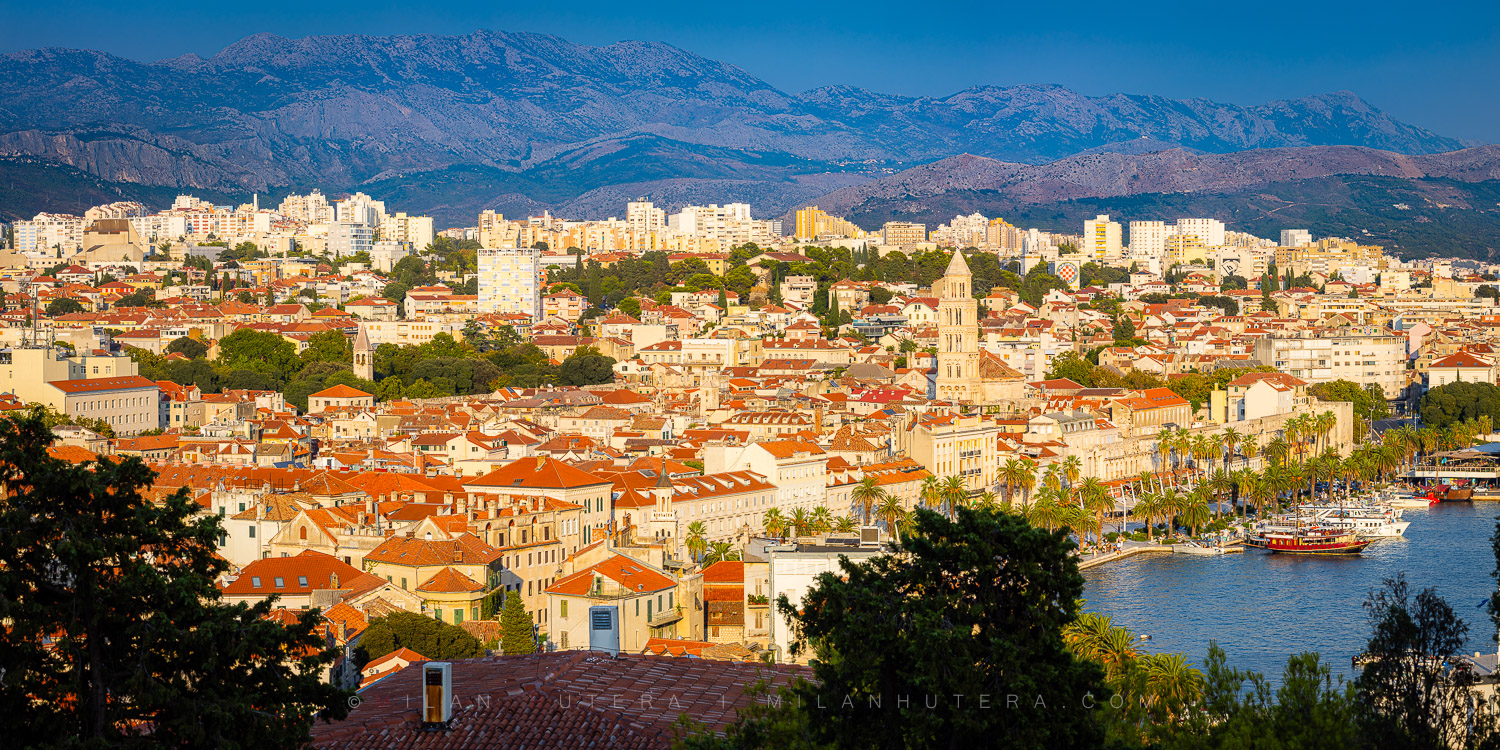
Split panorama from Marjan Hill brings together the historic centre, the waterfront and the rugged mountains rising behind Croatia’s second-largest city. I photographed this view from the terrace of Vidilica restaurant on Marjan Hill in intense late-afternoon light, using a telephoto lens. The layers of red rooftops, church towers and modern neighbourhoods stand out against the dramatic mountain backdrop.
The bell tower of the Cathedral of Saint Domnius rises prominently above the historic centre. Much of the old city developed around Diocletian’s Palace, which Roman Emperor Diocletian built around the turn of the 4th century AD. Over the following centuries, the palace gradually became part of the living city rather than remaining an isolated ancient monument. Today, Roman structures, medieval churches and later Gothic, Renaissance and Baroque buildings coexist within the historic centre. UNESCO inscribed the Historical Complex of Split with the Palace of Diocletian on the World Heritage List in 1979.
Along the waterfront, the palm-lined Riva separates the dense historic fabric from the Adriatic Sea. From this elevated viewpoint, however, it becomes only one layer within a much larger urban landscape. The historic stone city in the foreground gradually gives way to newer districts, while the mountains form a natural wall across the horizon.
The Split panorama from Marjan Hill is especially well suited to a telephoto lens. The compressed perspective visually pulls the distant mountains closer to the city and emphasises how tightly Split sits between the Adriatic coast and the rugged Dalmatian landscape.
Copyright Milan Hutera, 2026. All Rights Reserved.
 Trogir Twilight Panorama, Croatia12/09/2026 - 11:29
 Primošten Scenic View Panorama, Croatia11/09/2026 - 10:50
 St. James Cathedral Ceiling, Šibenik, Croatia10/09/2026 - 16:50
 Šibenik Old Town Street, Croatia10/09/2026 - 15:50
 Trogir Old Town Courtyard, Croatia09/09/2026 - 16:45
 Split panorama from Marjan Hill, Croatia08/09/2026 - 18:15
 Gregory of Nin Statue, Split, Croatia08/09/2026 - 16:40
 Diocletian’s Palace Vestibule, Split, Croatia08/09/2026 - 15:27
 Primošten Hazy Sunset, Croatia06/09/2026 - 20:05