
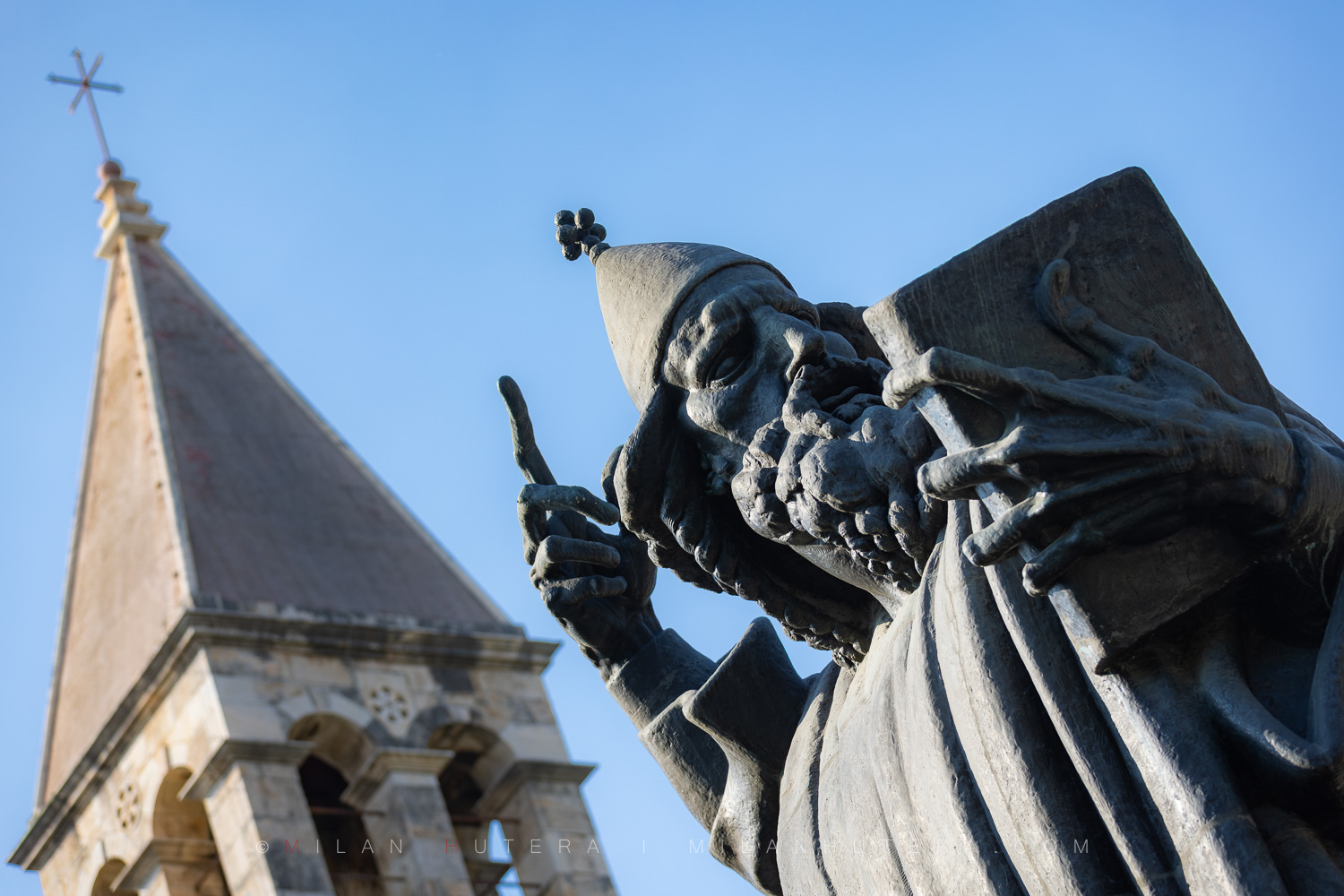
Gregory of Nin statue in Split stands above the viewer near the northern entrance to Diocletian’s Palace. Croatian sculptor Ivan Meštrović gave the medieval bishop a monumental presence, with one hand holding a book and the other raised in a commanding gesture. Behind the bronze figure, the bell tower of St. Arnir adds another layer of Split’s long history to the composition.
Gregory served as Bishop of Nin in the early 10th century and became an important figure in Croatian cultural memory. Tradition associates him with the defence of Old Church Slavonic in worship and the use of the Glagolitic script. His role has gained an almost symbolic importance in the story of Croatian language and identity.
Ivan Meštrović created the enormous bronze monument in the early 20th century. Standing almost 8 metres high, it became his largest public monument. The statue originally stood on the Peristyle of Diocletian’s Palace, where it was installed in 1929. Authorities removed it in 1941 during the Second World War, and in 1954 the monument returned to public space at a new location. Today, it stands just outside the Golden Gate of the palace.
The Gregory of Nin statue in Split is now one of the city’s best-known landmarks. Its enormous scale becomes especially apparent from close range, where Meštrović’s expressive modelling and exaggerated hands dominate the view. A popular local tradition says that touching Gregory’s big toe brings good luck or makes a wish come true. Decades of visitors have worn the bronze surface smooth and bright.
Copyright Milan Hutera, 2026. All Rights Reserved.
 Trogir Twilight Panorama, Croatia12/09/2026 - 11:29
 Primošten Scenic View Panorama, Croatia11/09/2026 - 10:50
 St. James Cathedral Ceiling, Šibenik, Croatia10/09/2026 - 16:50
 Šibenik Old Town Street, Croatia10/09/2026 - 15:50
 Trogir Old Town Courtyard, Croatia09/09/2026 - 16:45
 Split panorama from Marjan Hill, Croatia08/09/2026 - 18:15
 Gregory of Nin Statue, Split, Croatia08/09/2026 - 16:40
 Diocletian’s Palace Vestibule, Split, Croatia08/09/2026 - 15:27
 Primošten Hazy Sunset, Croatia06/09/2026 - 20:05