
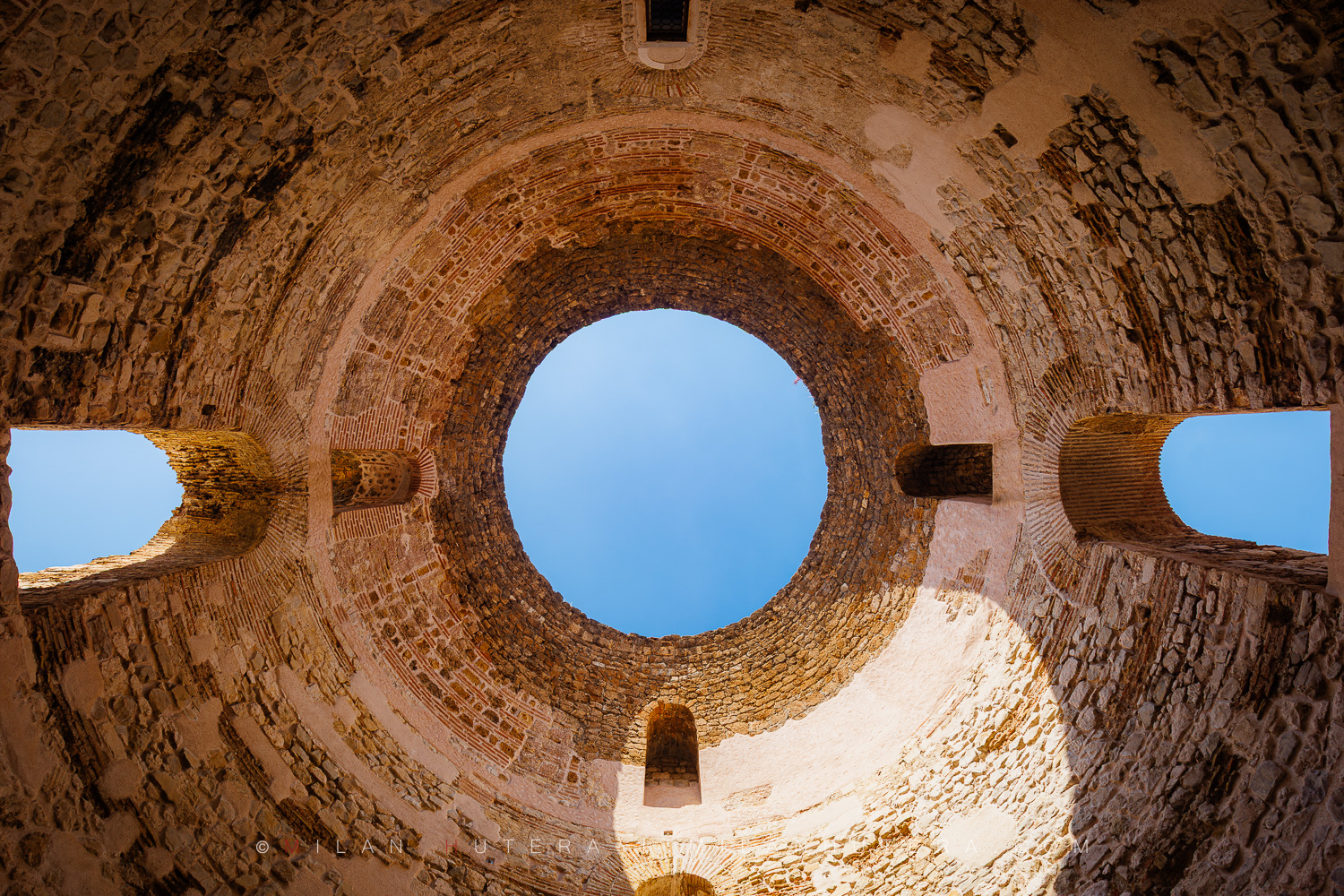
Diocletian’s Palace Vestibule opens dramatically towards the sky through the circular oculus above its ancient stone walls. Looking straight upward reveals the complexity of this Roman ceremonial space, where layers of brick and limestone form a near-perfect circle around the blue sky. I took this photograph lying on my back, and even at 16 mm, it was barely possible to fit the entire structure into the frame.
The Vestibule once served as the monumental entrance to the residential part of Emperor Diocletian’s palace. Visitors passed through it from the Peristyle before entering the imperial apartments. Although its exterior has a rectangular form, the interior is circular, creating one of the most striking architectural contrasts within the palace.
In Roman times, the space looked considerably more luxurious than it does today. Historical descriptions mention semicircular niches containing statues and a large dome decorated with colourful mosaics. The Croatian humanist Marko Marulić still recorded traces of this decoration in the 16th century. Over the centuries, however, the original dome disappeared, leaving the dramatic open oculus that now frames the sky above Split.
Today, the Diocletian’s Palace Vestibule is one of the most atmospheric surviving spaces in the palace. Its circular walls, exposed masonry and open roof make the structure feel both monumental and surprisingly abstract when viewed from directly below.
Copyright Milan Hutera, 2026. All Rights Reserved.
 Trogir Twilight Panorama, Croatia12/09/2026 - 11:29
 Primošten Scenic View Panorama, Croatia11/09/2026 - 10:50
 St. James Cathedral Ceiling, Šibenik, Croatia10/09/2026 - 16:50
 Šibenik Old Town Street, Croatia10/09/2026 - 15:50
 Trogir Old Town Courtyard, Croatia09/09/2026 - 16:45
 Split panorama from Marjan Hill, Croatia08/09/2026 - 18:15
 Gregory of Nin Statue, Split, Croatia08/09/2026 - 16:40
 Diocletian’s Palace Vestibule, Split, Croatia08/09/2026 - 15:27
 Primošten Hazy Sunset, Croatia06/09/2026 - 20:05