
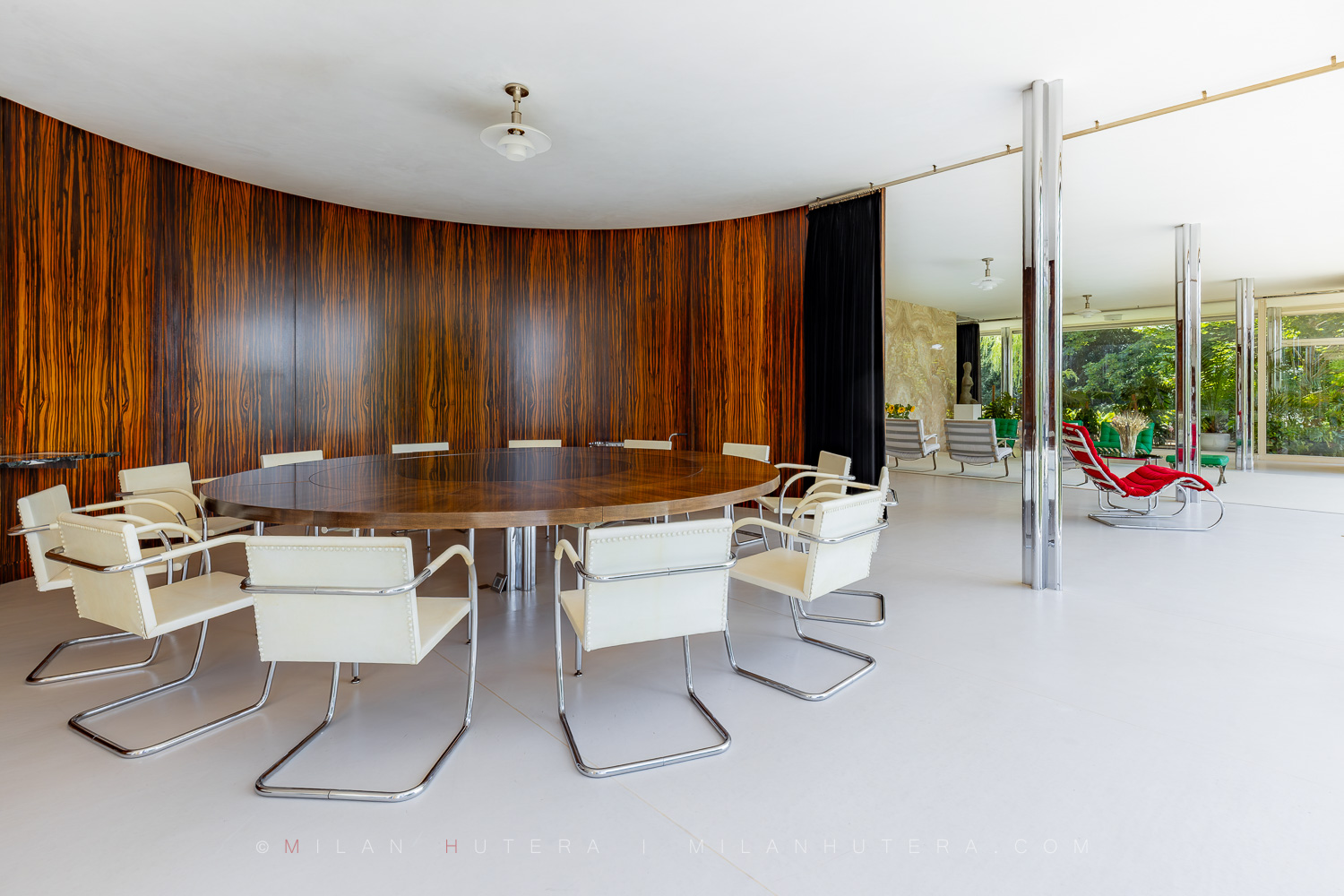
The Villa Tugendhat dining area showcases one of the most remarkable wood interior elements in modern architectural history. My photo reveals the semicircular dining wall made of rare Macassar ebony, creating an intimate, elegant dining space within the villa’s vast open-plan interior.
Architectural Highlights & The Lost Ebony Wall
-
Macassar Ebony Wall: The curved partition wall crafted from dark, heavily figured Macassar ebony wood visually separates the dining space from the main living room while maintaining the fluid flow of the open layout.
-
A Wartime Detective Story: In 1940, during the German occupation, the precious ebony wall vanished from the villa and was long presumed destroyed or lost forever. Decades later, art historians tracked it down to the nearby Masaryk University Law Faculty—which served as the Gestapo headquarters during WWII. The Nazis had dismantled the wall and repurposed the wood as wall panelling for their officers’ canteen. Unaware of its origins, students and staff dined beside this iconic modernist treasure for over 60 years.
-
Return & Restoration: During the major restoration of Villa Tugendhat (2010–2012), the original wooden panels were carefully removed from the university, restored, and reassembled back into their original curved form shown in this photograph.
-
The Brno Chairs: Surrounding the round dining table are the iconic tubular steel Brno chairs upholstered in white parchment/leather, custom-designed by Ludwig Mies van der Rohe and Lilly Reich specifically for this house.
Artist’s Note: Photographing the interior of Villa Tugendhat is allowed strictly for personal use, and a photo pass is required upon entering for the tour of the Villa.
Copyright Milan Hutera, 2026. All Rights Reserved.
 Trogir Twilight Panorama, Croatia12/09/2026 - 11:29
 St. James Cathedral Ceiling, Šibenik, Croatia10/09/2026 - 16:50
 Šibenik Old Town Street, Croatia10/09/2026 - 15:50
 Split panorama from Marjan Hill, Croatia08/09/2026 - 18:15
 Diocletian’s Palace Vestibule, Split, Croatia08/09/2026 - 15:27
 1874 Žlutý Kopec Water Reservoir, Brno, Czech Republic09/07/2026 - 21:30
 1917 Žlutý Kopec Water Reservoir, Brno, Czech Republic09/07/2026 - 21:25
 1894 Žlutý Kopec Water Reservoir, Brno, Czech Republic09/07/2026 - 21:20
 Villa Tugendhat Dining Area, Brno, Czech Republic09/07/2026 - 12:25